Lipid Nanoparticles (LNPs): Advantages, Applications & Preparation
What Are Lipid Nanoparticles?
Lipid nanoparticles (LNPs) are nanoscale delivery systems composed of lipid-based materials, typically 50–150 nm in diameter. They are widely used in pharmaceutical, biotechnology, and industrial formulation applications to encapsulate and transport therapeutic molecules.
By forming a core stabilized by a lipid shell, LNPs provide effective protection for sensitive compounds and enable controlled release and efficient cellular delivery.
Advantages and Applications of LNPs
Advantages of LNPs:
- High stability: Protects sensitive drugs from degradation.
- Improved cellular uptake: Lipids help drugs enter cells.
- Optimized biodistribution: Ensures targeted delivery and longer circulation.
- Versatility: Can carry nucleic acids, small molecules, or hydrophobic drugs.
- Scalable production: Suitable for lab research and industrial manufacturing.
Applications of LNPs:
- mRNA vaccines: Protect RNA and enhance immune response.
- Gene therapy: Deliver RNA or DNA safely to target cells.
- Small molecule drugs: Improve solubility, stability, and targeted delivery.
- Cosmetics and nutraceuticals: Controlled release of active ingredients.
Preparation of Lipid Nanoparticles
To achieve consistent performance, lipid nanoparticles must be produced using preparation methods that provide reproducible particle size and stability while supporting scale-up. Common LNP preparation techniques include thin-film hydration, solvent injection, double emulsion methods, microfluidic mixing, and mechanical size-reduction processes.
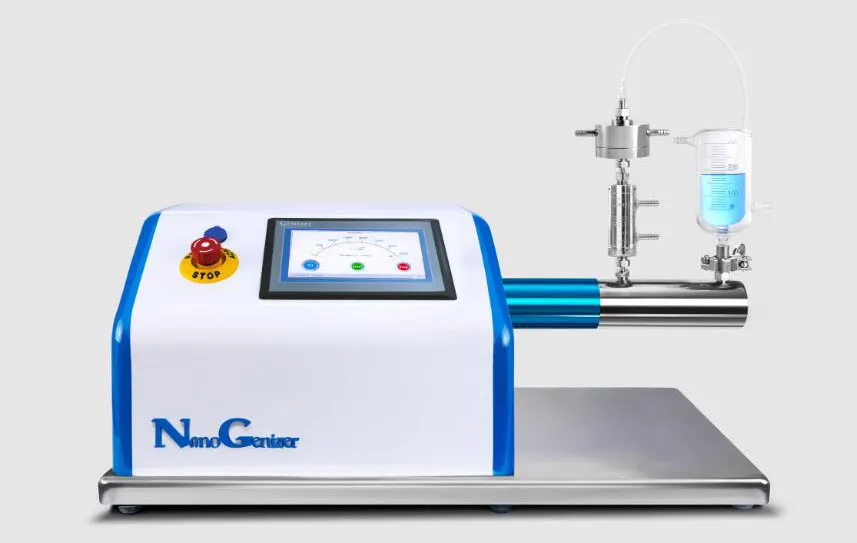
Among these approaches, high-pressure homogenization is widely adopted for scalable production. By using the diamond interaction chamber to generate mechanical forces such as high shear, cavitation, impact, and high-frequency oscillation, the high-pressure homogenization method avoids complex microstructures and disposable components, making it ideal for both laboratory process development and large-scale manufacturing.
High-Pressure Homogenization Process
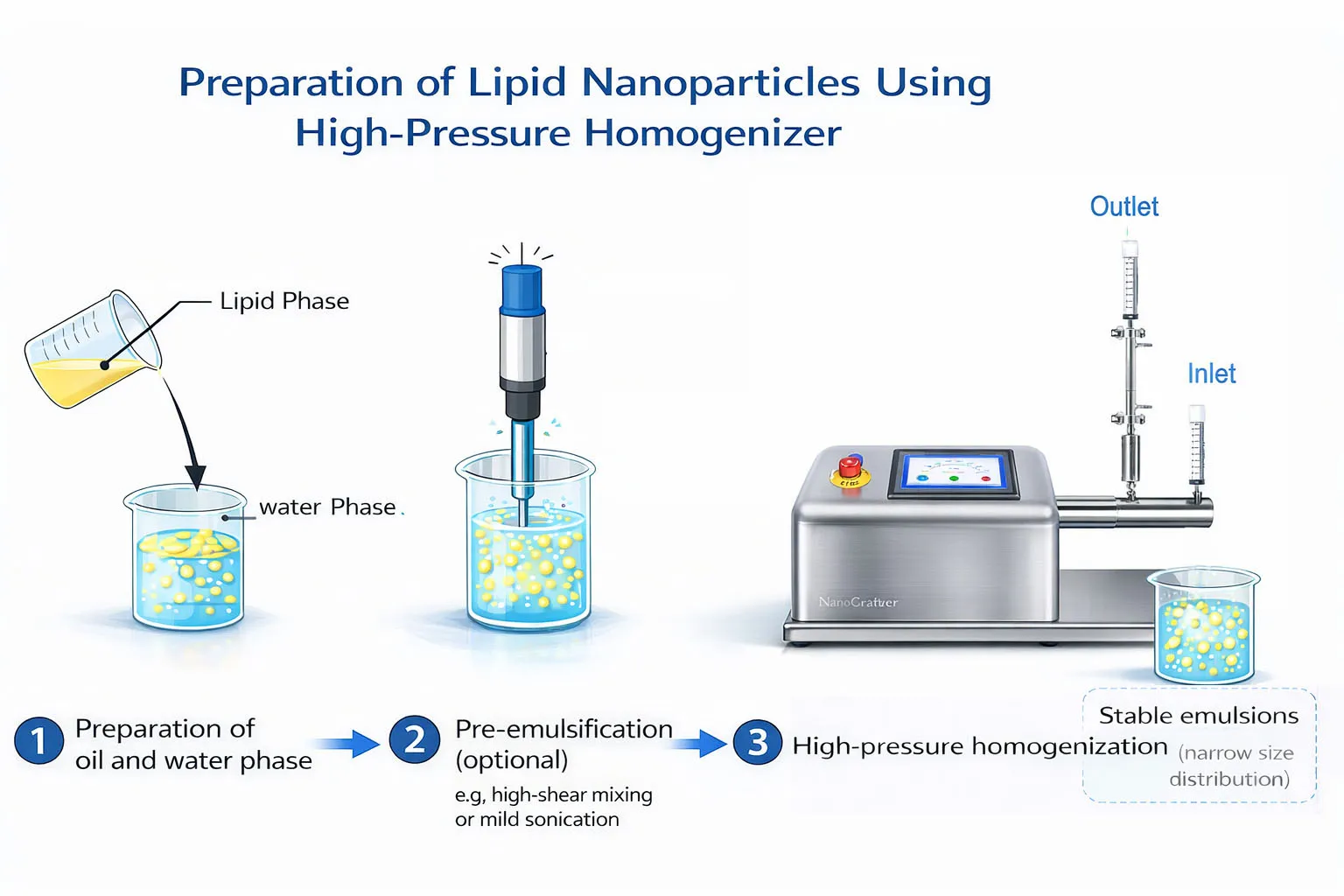
First, the drug is dissolved or dispersed in molten lipids, then mixed with an aqueous surfactant solution. Optional pre-emulsification steps, such as high-shear mixing or mild sonication, can be applied to improve initial dispersion but are not required. The mixture is then processed through a high-pressure homogenizer to produce a uniform and stable emulsion. After cooling to room temperature, stable lipid nanoparticles are obtained.


Comments
Post a Comment